How to Choose the Right Precision CNC Grinding Machine?
Choosing the right Precision CNC Grinding Machine is crucial for manufacturers seeking optimal efficiency and accuracy in production. According to a recent industry report by Technavio, the global CNC grinding machine market is expected to grow by 3.5% annually, driven by advancements in automation and precision engineering. This underscores the growing demand for high-quality grinding solutions.
Expert David Miller, a leading authority in CNC technology, emphasizes, "Selecting the right machine can significantly impact production costs and product quality." His words highlight the importance of informed decision-making in this highly competitive field. A well-chosen Precision CNC Grinding Machine can enhance precision in processes like tool and die making, automotive parts production, and aerospace components.
However, many companies face challenges in evaluating their options. The variety of features and specifications can be overwhelming. Companies must reflect on their specific needs, production volumes, and material requirements. A misstep in selection can lead to increased downtime and cost overruns. The precision of your machinery directly correlates to overall productivity and efficiency.
Understanding the Different Types of Precision CNC Grinding Machines
Choosing the right precision CNC grinding machine requires a clear understanding of the various types available. Precision CNC grinders generally fall into three main categories: cylindrical, surface, and tool & cutter grinders. Each type serves unique applications and varies in capabilities. For instance, cylindrical grinders can handle round workpieces, providing excellent dimensional accuracy, while surface grinders are ideal for creating flat surfaces.
According to a report from Grand View Research, the global CNC grinding machines market is projected to reach USD 5.6 billion by 2027. This growing demand highlights how crucial it is to select the right machine for specific tasks. An understanding of the materials being processed can greatly influence this choice. For example, certain machines excel at grinding hard metals, while others are better for softer materials.
Choosing the right grinder also involves evaluating production volume and required tolerance levels. Limited budgets can lead to poor choices, resulting in inefficiencies. Some businesses have made the mistake of opting for a less precise machine to save costs, only to face difficulties later. Therefore, understanding your operational needs is vital. Making an informed decision can yield long-term benefits, enhancing overall productivity and quality control.
How to Choose the Right Precision CNC Grinding Machine?
| Machine Type |
Capabilities |
Best For |
Typical Applications |
| Cylindrical Grinding Machine |
External and internal surfaces |
General-purpose grinding |
Shafts, pins, rods |
| Surface Grinding Machine |
Flat surfaces finishing |
Precision flat workpieces |
Plates, sheets |
| Tool and Cutter Grinding Machine |
Sharpening cutting tools |
Tool manufacturing |
Drills, end mills, reamers |
| Angular Grinding Machine |
Accuracy in angular surfaces |
Angle-critical projects |
Gears, complex part geometries |
| Centerless Grinding Machine |
No need for centering |
High-volume production |
Bar, tube parts |
Key Factors to Consider When Selecting a CNC Grinding Machine
When selecting a CNC grinding machine, several key factors demand attention. Precision is crucial; it determines the machine's capability to produce accurate parts. Consider the machine's tolerance levels, as they significantly influence part quality. Look for features that enhance precision, such as superior spindle design. Choosing the right spindle can greatly enhance the machining process.
Another critical factor is the size of the workpiece. Your machine must accommodate your specific applications. Analyze the maximum dimensions your projects require. A machine too small will be limiting. Equally, check the machine's weight capacity. If it cannot handle your parts, it’s not a suitable choice. An overloaded machine might lead to breakdowns and financial loss.
Additionally, operator skill variability is worth considering. More complex machines may require advanced training. Determine if your team is prepared for the learning curve. Investing in a technologically advanced machine can deliver results but also demands diligent training. Align the machine's capabilities with your workforce skills to optimize productivity. These reflections will guide more informed decision-making.
Key Factors to Consider When Selecting a CNC Grinding Machine
This bar chart illustrates the key factors to consider when selecting a CNC grinding machine, with a focus on their importance level ranked from 1 to 10. Cost, precision, and speed emerge as the most critical factors in decision-making.
Evaluating the Technical Specifications of CNC Grinding Machines
When evaluating the technical specifications of CNC grinding machines, consider several critical factors. The machine's rigidity, for instance, plays a vital role in achieving precision. A study by the International Journal of Advanced Manufacturing Technology indicates that machines with higher stiffness provide better surface finishes and tighter tolerances. Look for machines with a high-quality base and vibration damping features.
Another essential specification is the motor power and spindle speed. Machines with powerful motors can handle tougher materials while maintaining consistent production rates. According to data from the Precision Engineering Institute, a spindle speed of at least 10,000 RPM enhances productivity significantly. It’s crucial to assess the balance between speed and power to avoid overheating and tool wear.
Tips: Always verify the machine's load capacity. Also, inspect the grinding wheels and their compatibility. Upgrading to more advanced cooling systems can prevent thermal expansion, which often leads to inaccuracies. Remember, the right specifications can enhance efficiency but need to match the specific production needs. Research and test machinery whenever possible to ensure it meets your requirements before making a final decision.
Analyzing Cost vs. Quality in CNC Grinding Machine Selection
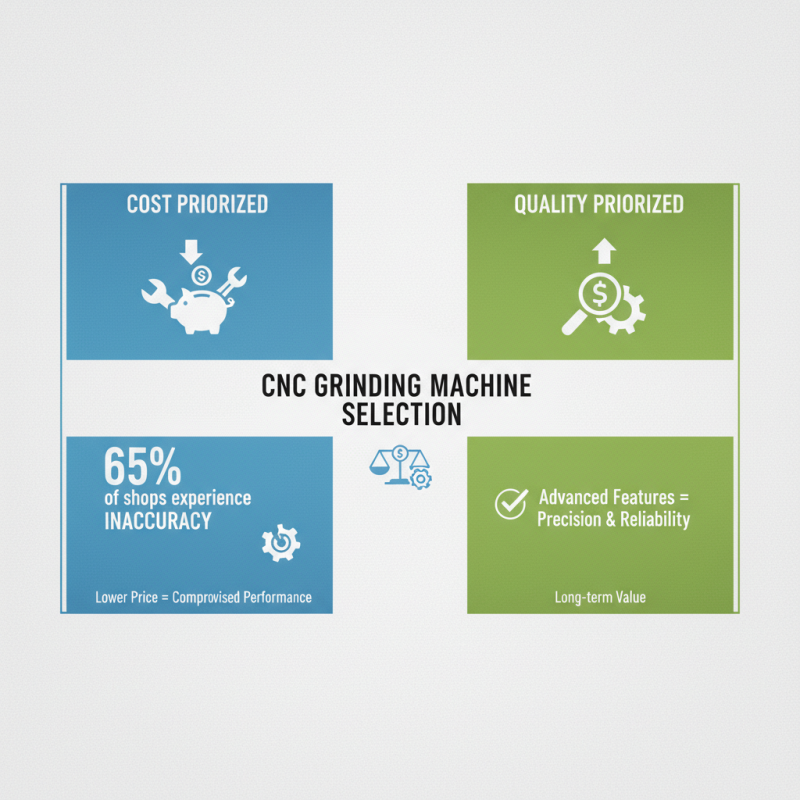
When selecting a precision CNC grinding machine, balancing cost and quality is vital. A recent industry report indicated that 65% of shops experience challenges with machine accuracy when cost is prioritized over quality. Lower-priced machines may lack advanced features, resulting in compromised performance.
Consider this: investing in a high-quality machine can yield significant returns. A reliable CNC grinder can enhance process efficiency by up to 30%, according to data from the Precision Machined Products Association. This efficiency translates to cost savings over time, making the initial investment more justifiable.
Tips: Always review the machine specifications. Look for precision tolerances and material compatibility. Avoid compromising on essential features like wheel quality and software capabilities. Remember that a machine's price tag often reflects its durability and performance.
It's crucial to analyze long-term operational costs. Often, cheaper machines incur higher maintenance fees. Before choosing, assess the total cost of ownership, factoring in potential downtime and repair expenses. Balancing these elements can lead to better decisions in CNC grinding machine selection.
 +86 13630122007

 CONTACT YIYAN
 CONTACT YIYAN